

Obsolescence
The perils of writing about a world you're not part of

I’m working on revisions to my next horror novel, Incarnate. (Update: finished!) I’m working from notes from my editor and literary agents and boy, are there a lot of them.
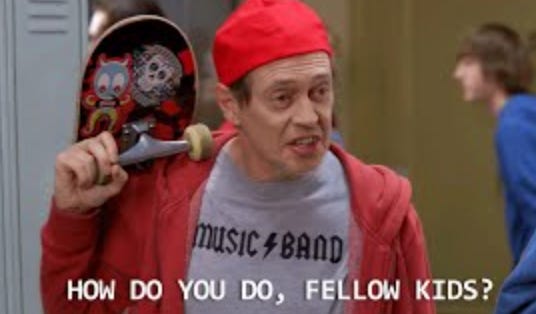
I knew it would be challenging. The book is about social media and AI and other sub-categories of technology, but it’s really about how these technologies have changed humans in ways we didn’t anticipate. I was (foolishly) excited to write about this because it had been my job for over a decade, as a tech futurist. I (foolishly) thought people might find interesting what I have to say about it.
I’m joking—a little. Of course the editor and agents believe in the idea behind the book, or they wouldn’t have encouraged me to write it. And, since I was doing a lot of research on social media during its early days for the intelligence community, I do have insights maybe beyond what the casual X or Facebook user might have.
The big problem wasn’t going to be dealing with technical aspects of computer security or all the other tech stuff that comes up in the book, but in dealing with the protagonist, a woman in her early 20s. She’s a Gen Z-er. Now, I haven’t had many dealings with Gen Z1 beyond casual exchanges on socials or in social settings but I know from what I’ve read and what others have told me that Gen Z thinks very, very differently from other generations. Some members of my generation, the lucky sonofabitches know as Boomers (yes, I’m a Boomer) consider them unfathomable.
My agents and editor very wisely asked Gen Z-ers in their offices read my manuscript and whoo boy, did they have thoughts. Pages and pages of thoughts that nailed home that, at least in the U.S., Gen Z sees the world very differently than previous generations. Of course: they’re the first generation to never know the world before social media, and social media completely changed everything (if you weren’t raised in a cult or something).
I was very pleased to learn from these notes that Gen Z has overcome the hangups of previous generations. They are completely body confident and would never think of being ashamed for being overweight. Also, Gen Z women have never harbored ill-will toward another woman—go sister power. They never bully each other, never squabble.
I kid, of course. But it does make me wonder how I’m going to square the circle: my characters have issues, especially my protagonist. She is competitive and ruthless and she’s been scarred by an incident in childhood. She is not perfect and she does not have all the answers—though she thinks she does.
Let’s disregard some of the objections undoubtedly arising in your mind right now and skip over to one I can’t argue with: maybe it’s time for me to stop writing twenty-ish protagonists. The experiences I had in my early twenties are just too dissimilar from those of people in their early 20s today. I can’t know what their lives are like, not on a deep level.
Now, I’m going to put in the hard work on Incarnate. I’m going to work through their notes (pages and pages and pages of them) to try to make my main character (MC) as accurately Gen Z as I can.2 But the real lesson here might be that I need to move on from writing protagonists of that generation. After all, I may not know much about what challenges today’s 20-year-olds, but I do know what’s challenging 50, 60 year-olds. I might dip down to the 40s, but probably not the 30s. Not for a MC.
I know this may sound like heresy to some. Writing and reading are, after all, about imagined experiences. Theoretically, you can write from the perspective of anyone or even anything you’d like (in grad school, I was roundly attacked for writing a story from the POV of a wild monkey) as long as you’re consistent in that character’s world view.
I hope that the MC of Incarnate will work for Gen Z readers. I don’t think of Gen Z as the target audience for the novel, though I worry that readers of earlier generations might not want to give the book a try. I confess, I sometimes do not enjoy stories with very young MCs, stories where the MC bounces around like a ping pong ball and doesn’t seem to know their own mind. I have a theory that stories like this are a half-step above Young Adult: the MCs are unformed, like balls of dough, with little experience of the world. They constantly find themselves in situations that are bewildering. If you like stories like this, more power to you, but I find this annoying. I’m old and I like characters who, too, have experienced something of the world and use this experience to guide them.
So Incarnate is not about a clueless 20-something; it’s about a very smart, calculating 20-something who tries to do something outrageous and audacious but nonetheless has blind spots that bring about her downfall. While this behavior is, on one level, very Gen Z (“I can do anything”), I think it’s also universal.
Anyway, more on Incarnate to come. And while I’ve just written a story with a 12-year-old MC for The Big Bad Book of Kaiju (coming July 2026), expect to see more mature protagonists from me in future.
Do women horror writers face bias? Sadie Hartmann (Mother Horror) and I are in the LA Review of Books talking about the realities faced by women working in the field, with shout-outs to many of today’s outstanding female horror writers.
Also in the LA Review of Books: it’s not so much a review of Fiend as it is a really good synopsis. “A cool and engaging literary treat that allows readers to imagine a world where the superrich are made to face the monsters within.”
Recommendation

This week’s recommendation is pretty niche but if you like vintage guitars (like my husband) and RVs (like me), you should check out Emerald City Guitars’ “GuitaRV” videos on YouTube. This guitar shop in Seattle takes its RV on the road to check out the vintage musical equipment people want to sell, and makes videos to document the trip. They make it look like SO MUCH FUN. They have a network of collectors they deal with so the stuff they see is primo, legendary guitars and amps. The GuitaRV videos are mixed in with the ones they make to sell certain pieces of equipment so you have to pick through to find them, but if these things are your jam, it’s worth the effort.
Because I don’t say it often enough, thanks for reading this newsletter, all the previous newsletters, my books.

Know someone who might enjoy these newsletters? Consider forwarding this to them.
Generally, Gen Z is defined as having been born between 1997 and 2012.
I hope that the kind souls who gave me these notes realize that their views represent a body of one; that their generation is not the Borg collective and they do not speak for everyone. Is there not one Gen Z-er who is insecure about her body? Not one who has said something catty to a classmate? I’ll try not to roll my eyes too loudly here.
It's nice to think that Gen-Z has it together with respect to body positivity, anti-bullying, etc. However, I know of at least three Gen-Z females that have and are still dealing with eating disorders due to body shaming (1 born in 1997 and 2 born in 2007), as well as one that has dealt with bullying from other females.
And I'm excited about your new book--this topic and your experiences shaping it!